"I am a decorator and I love light. With it, I wish to create an atmosphere of joy and beauty."
— Fernand Jacopozzi
I1877 — 1900
Florentine Origins
Born under the Tuscan sun, destined for the lights of Paris
Fernand Jacopozzi was born on 12 September 1877 in Florence, into a family of the Florentine bourgeoisie. It was nascent electricity that would captivate the young man — that invisible force, barely out of the laboratories, capable of conjuring light from nothing.
After engineering studies in Florence, he left for Paris in 1900, aged twenty-two. France was in ferment: the World's Fair was illuminating the banks of the Seine, and the entire city seemed to be a single enormous lantern.
Florence in the late 19th century — Fernand Jacopozzi's birthplace.
Family archives
II1902 — 1916
The First Lights
Shop fronts, signs and cinemas: a Parisian apprenticeship
Paris absorbs him. Fernand Jacopozzi first works for the firm of Paz et Silva, then founds his own workshops — Jacopozzi et Cie in 1903, specialising in shop-front and sign decoration, then the Établissements Jacopozzi in 1907. His signature: the animated luminous sign, those letters that seem to write themselves in the night.
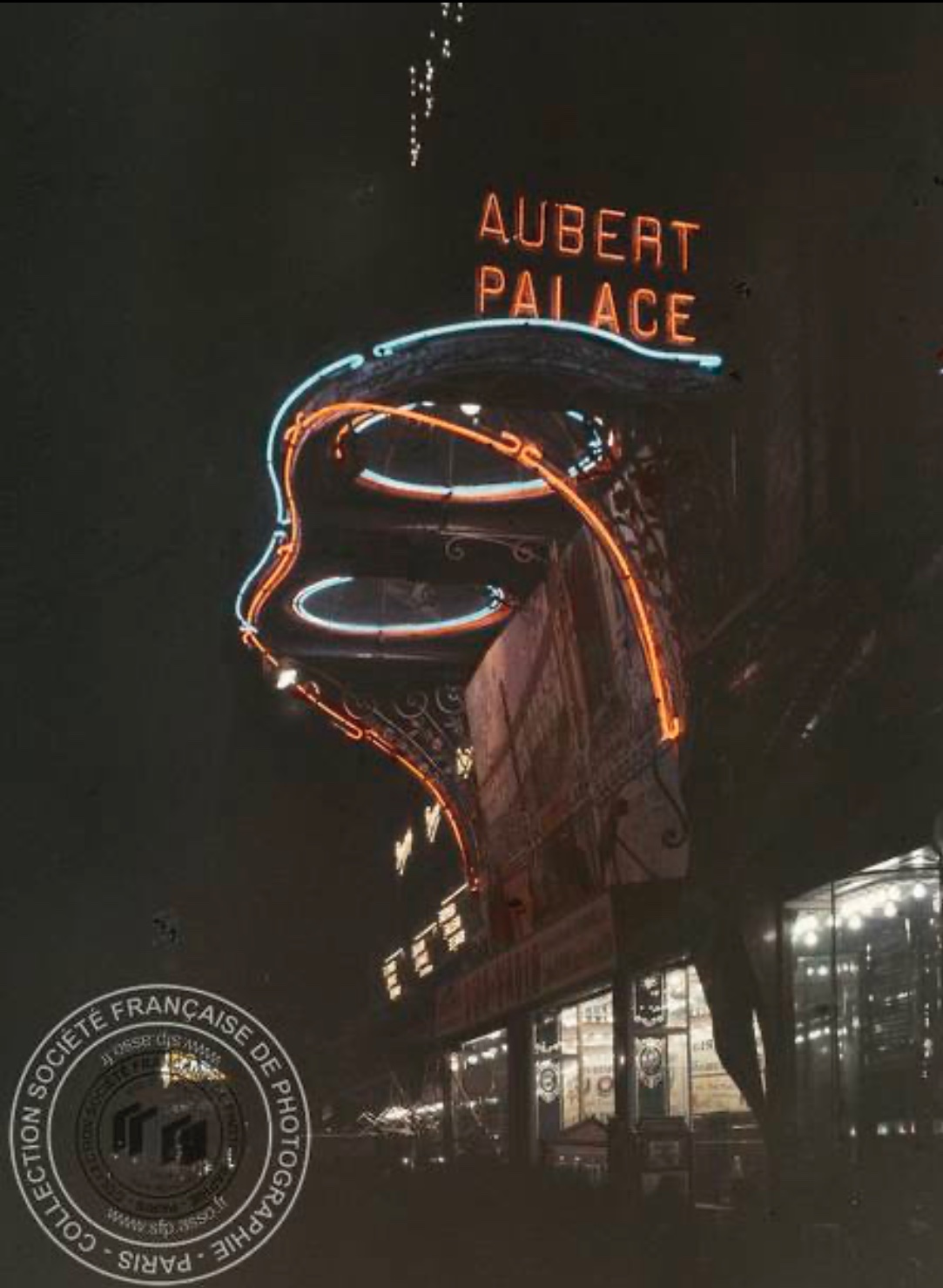
He is also a cinema architect: he designs and builds several of the first great Parisian cinemas — the Passy in 1912, the Aubert-Palace in 1915. Whole façades become covered in bulbs that light up in sequence. Crowds stop, mouths agape. Newspapers speak of "enchantment." Scene after scene, Fernand Jacopozzi learns to make light a spectacle.
Jacopozzi Archives
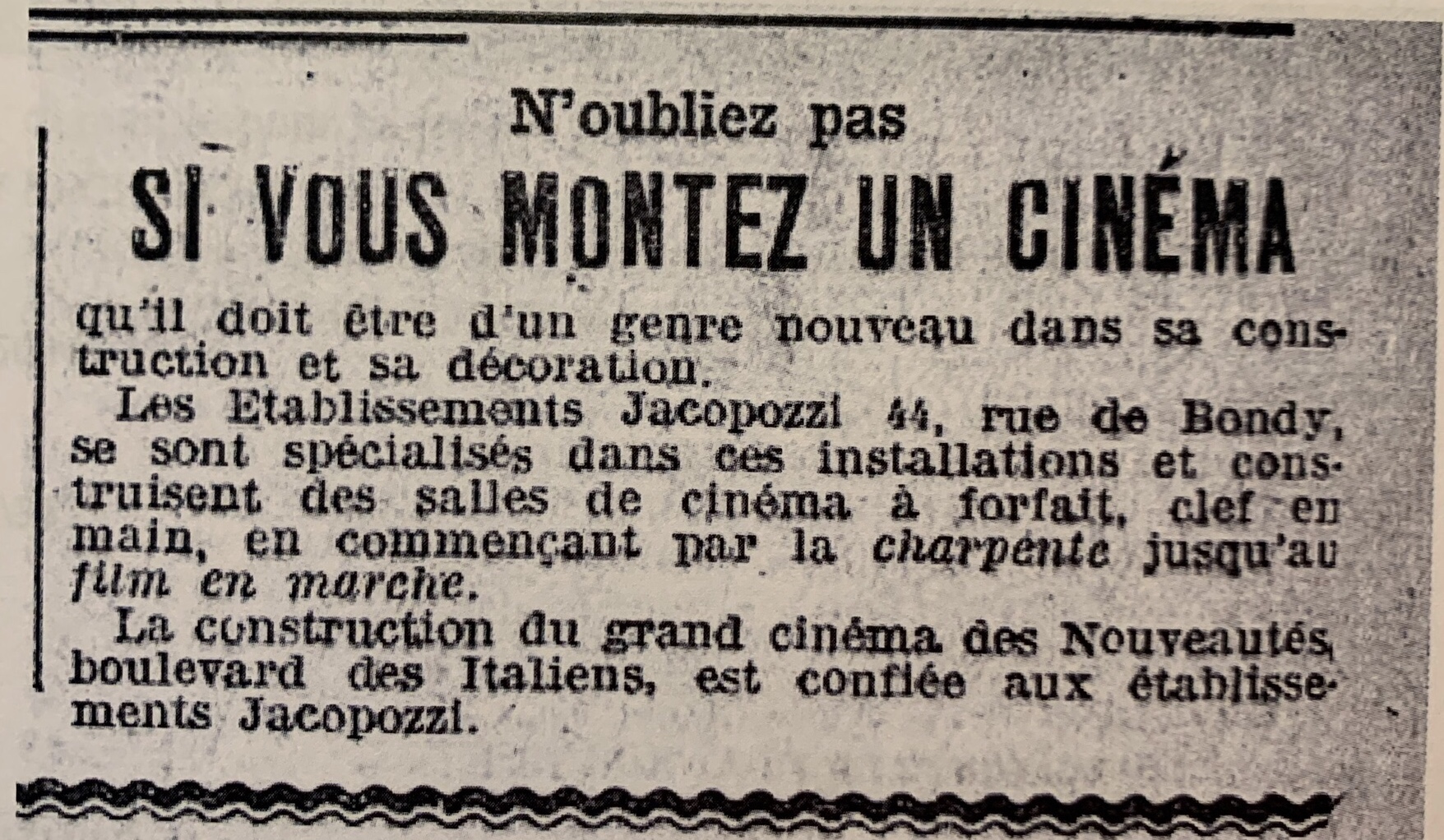
"If you are building a cinema" — the Établissements Jacopozzi, rue de Bondy, built halls turnkey, "from the framework to the running film." The grand Cinéma des Nouveautés, boulevard des Italiens, was entrusted to them.
Jacopozzi Archives
Worth knowing
From 1919, the Magasins du Louvre, on the Rue de Rivoli, would become his most faithful Christmas client — 13 consecutive Christmases of animated illuminations, until his death in 1932. Every December, Parisians crowded before the façade to see his new creations.
These years of apprenticeship teach him the essential: light is not decoration, it is narration. Every bulb is a note, every garland a phrase. The illuminator is a composer of light.
Société française de photographie
The Aubert-Palace, boulevard des Italiens — one of the great Parisian cinemas designed by Jacopozzi, illuminated sign included.
Collection Société française de photographie (SFP)
III1917 — 1918
The Fake Paris
Classified defence: deceiving German bombers
In 1917, as German zeppelins and Gotha bombers raided Paris night after night, the French government called on Jacopozzi for an audacious mission without precedent: to build a fake Paris to the north of the city, at Villepinte and Aubervilliers, to mislead enemy aviators.
The mission was classified. Jacopozzi reproduced at near full scale the railway junctions most visible from the air: the Gare de l'Est, the outskirts of Saint-Denis and Aubervilliers. Fake rails painted on tarpaulins, false luminous signals, a phantom station glowing in the night, drawing bombs away from real infrastructure.
The operation remained unknown for decades. Military archives were only partially declassified after the Second World War. Jacopozzi himself never spoke of it — not from modesty, nor from force of habit, but because some lights are made not to be seen.
Reconstruction of the Fake Paris luminous device — false railway tracks and light signals designed to mislead enemy bombers.
Military archives / DR
IV1925
The Iron Lady
250,000 bulbs, Citroën's name in the Paris sky
On 4 July 1925, for the International Exhibition of Decorative Arts, Paris held its breath. The idea was Jacopozzi's own: to illuminate the entire Eiffel Tower, from base to summit. It was he who approached André Citroën and convinced him to finance the project — in return, the Tower would carry the brand's name.
250,000 bulbs, 57 kilometres of wire, seven luminous letters thirty metres high: C · I · T · R · O · Ë · N. Projectors swept the sky, comets of light climbed the pillars, and the brand name blazed at 300 metres altitude, visible forty kilometres in every direction.
The installation remained in place until 1934. For nine years, the Eiffel Tower was the world's largest advertising sign — and Fernand Jacopozzi its author. Paris officially became the City of Light.
Key figures
250,000 bulbs · 57 km of wire · 6 colours · visible at 40 km · installed: 4 July 1925 · removed: 1934
V1925 — 1932
The Years of Light
Notre-Dame, the grands magasins, consecration
The success of the Eiffel Tower opens every door. Commissions pour in: Notre-Dame de Paris (1930), the grand façades of the Magasins du Louvre for each Christmas, the illumination of the bridges of Paris, the animated signs of the cinemas and theatres of the Grands Boulevards.
Jacopozzi does not merely illuminate — he animates. He invents the first sequential-bulb signs, those "luminous advertisements" whose letters seem to write themselves in the Parisian night. Crowds stop, children point, photographers immortalise. Paris glitters.
On 22 January 1932, two weeks before his death, France raised him to the rank of Commandeur de la Légion d'honneur. He was fifty-four. He died on 5 February 1932, in Paris, leaving a daughter, Donatella, born in 1921.
VI5 February 1932
The Disappearance
A flame goes out, a memory lights up
Fernand Jacopozzi is buried at Père-Lachaise cemetery, division 86. On his grave, no bulbs, no cables — just a plain stone in the city he illuminated for thirty years. The Eiffel Tower would shine two more years after his death in the name of Citroën, his posthumous masterpiece.
For decades, his name faded from memory. This site, created by his family, is a modest attempt to restore this man to his rightful place in the history of Paris and of light. His granddaughter Véronique has for years been collecting documents about her grandfather's work, to bring him back into the light he left too soon.
He remains, even today, the magician who made the night a spectacle and an entire city a lantern.